Moving to Alaska Cost and Transit Time: What Affects Your Quote
When planning a move to Alaska, one of the first questions people ask is: "How much will it actually cost, and will it take weeks or months?"
A customer moving from Austin, TX → Anchorage, AK used an online calculator to estimate their moving costs. Based on distance alone, it quoted around $6,500. Their official quote came back at $12,800. The gap came down to factors the calculator never asked about: season, destination, shipment size, and additional transportation stages.
Let's take a closer look at the key factors that influence your Alaska moving cost, delivery timeline, and overall relocation experience.
How Your Origin Location Influences Cost and Transit Time
Your starting location is a key factor in both cost and transit time to move to Alaska. The farther your origin is from the Western corridor, the more inland transport impacts your budget and timeline.

For Road Moves
West Coast (WA, OR, NorCal): Shorter routes, lowest costs, and fastest delivery (7–14 days).
Midwest & South (TX, FL, IL): Higher mileage adds $1,500–$3,000 to the baseline price and extends transit to 14–20 days.
East Coast (NY, MA, PA): The longest inland distance, adding $3,500+ in fuel/labor and taking 18–25+ days.
For Sea Shipping
Pacific Northwest (Seattle, Tacoma): Minimal trucking to port terminals keeps costs low and port delivery within 10–14 days.
California: Moderate inland trucking required before reaching PNW ports.
East Coast & South (NY, TX, FL): Long-haul trucking to Seattle adds $2,000–$4,000 to your ocean freight invoice and extends total transit time to 20–28 days.
Planning Tip: Distance sets the baseline, not the final cost. From the East Coast or South, compare road and sea quotes — port trucking can offset the longer drive for larger shipments.
How Your Alaska Destination Changes the Final Moving Price
Your destination's accessibility by road or sea can significantly impact both cost and delivery time.

For Road Moves
Accessible (Anchorage, Fairbanks, Wasilla, Palmer): On the highway system — direct delivery, lower cost, faster transit.
Less accessible (Homer, Valdez, Seward, Bush communities): Longer routes, limited carrier availability, or extra arrangements needed. Typically adds $300–$700+ in transit fees and 2–4 business days.
For Sea Shipping
Accessible (Anchorage, Kodiak, Juneau, Ketchikan): Regular vessel service — predictable schedules, lower cost
Less accessible (Sitka, Unalaska, remote islands/villages): Requires specialized barges, smaller vessels, or extra freight transfers. Adds $800–$2,000+ and 5–10 business days due to limited sailing schedules
Planning Tip: If your destination isn't on the main highway or port network, ask for the regional transfer fee breakdown upfront — movers can easily leave it off the initial quote and add it later.
How Shipment Size Affects Your Moving to Alaska Cost
Sea rates depend mainly on container space; road rates factor in both volume and weight per Federal Highway Administration standards.

Total Household Volume
For Road Moves
Studio or 1-bedroom: Often shipped via LTL (Less-than-Truckload), sharing truck space to cut costs: $4,500–$6,500
2–3 bedroom homes: Typically need dedicated trailer space, raising cost based on mileage and fuel: $11,000–$16,000+.
For Sea Shipping
Studio or 1-bedroom: Can be sent via LCL (Less than Container Load) with other freight: $3,500–$5,500 (more cost-effective for small volumes).
2–3 bedroom homes: Typically need FCL (Full Container Load) for dedicated space: $9,000–$14,000+ (often cheaper than a dedicated road truck for large homes)
Heavy and Oversized Items
Pianos, safes, large appliances, and oversized furniture need extra space and specialized packing or bracing to travel safely. This typically adds $150–$600+ per item, depending on complexity.
Planning Tip: Decluttering before your move can help reduce shipping costs. For larger moves, compare road and sea transportation to determine the most cost-effective option.
DIY Packing vs Professional Movers Liability and Costs
Packing costs depend on materials, labor, and whether you self-pack or use professional services to meet your route's protection requirements.

DIY Packing (PBO) vs Professional Packing
PBO (Packed by Owner): Lowest upfront cost, ideal for standard household goods. Damage from improper self-packing may not be covered under some valuation protection plans.
Carrier Packed (Professional): Higher cost, but uses professional materials and techniques — often with broader protection for fragile or high-risk items.
Route-Specific Requirements: Road moves focus on vibration protection (blankets, bubble and stretch wrap). Sea shipping needs heavy-duty moisture protection and load stability due to long-term stacking and sea movement.
Custom Crating: Delicate, high-value items (artwork, large TVs, chandeliers, musical instruments) need custom wooden crates, adding $150–$500+ per crate.
Planning Tip: Pack standard, non-fragile items yourself to save money, but consider professional packing for valuable, delicate, or oversized belongings that need extra protection.
Best Time of Year to Move to Alaska to Avoid High Rates and Hazards
The season you move to Alaska affects cost, carrier availability, and scheduling flexibility.
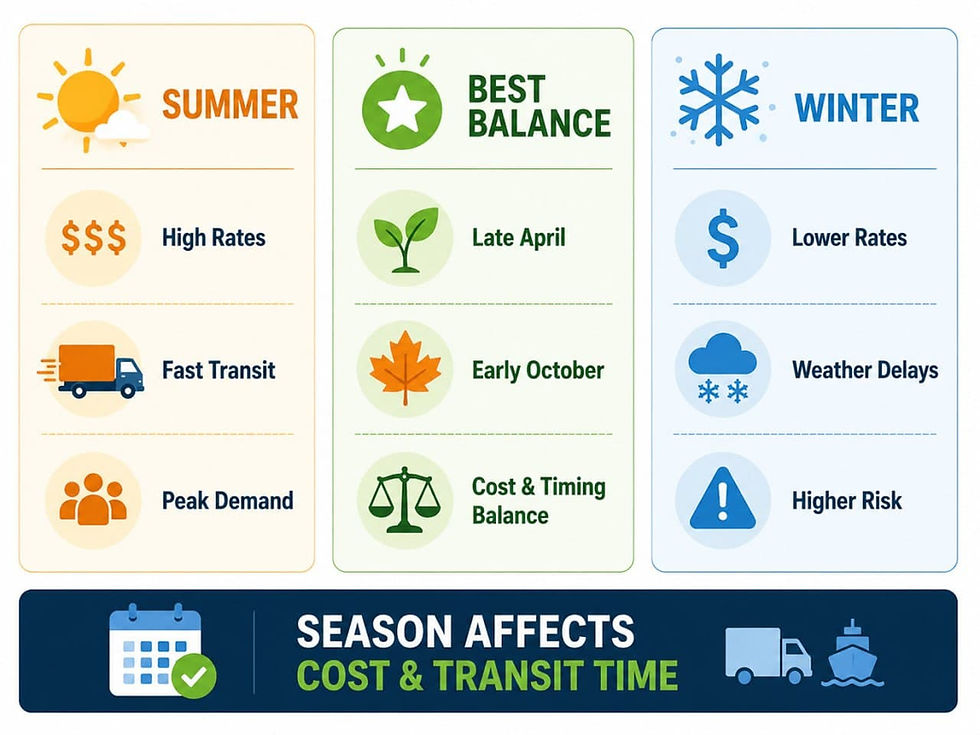
Peak Season (May–September)
Ideal weather, but peak rates and high demand.
Road: Fastest transit thanks to clear roads — but highest rates, plus minor delays from summer DOT roadwork.
Sea: Smooth sailing — but port congestion at Seattle/Tacoma means booking 8–12+ weeks ahead.
Winter Season (October–April)
Lower off-peak rates, but added operational risk.
Road (higher risk): Snow, ice, and pass closures can add 3–7 days — monitor Alaska 511 for route changes.
Sea (more predictable): Alaska ports stay ice-free year-round; storms cause only 1–3 days of delay, making winter shipping fairly reliable.
Planning Tip: For the best balance of cost, speed, and safety, target the "shoulder seasons" — late April or early October — for lower rates just before winter hazards or summer price spikes hit.
How to Avoid Unexpected Moving Shuttle Service Surcharges
Easy truck access keeps moving costs down, while access restrictions can raise the final price.

Standard Access
Large trucks can park close to the property.
Loading and unloading happens directly from the truck, no extra equipment needed.
Limited Access and Shuttle Service
Shuttle service is typically required when:
Roads are narrow or have tight turns
Driveways are steep or unpaved (common in Alaska's hilly or rural areas)
Low-hanging trees or utility lines are in the way
Commercial vehicle access is restricted
In these cases, movers transfer belongings from the main truck to a smaller vehicle for final pickup or delivery.
Cost Impact: Shuttle service typically adds $300–$800+ due to extra labor and equipment. A Long Carry Fee may also apply if items must be carried a long distance to the property.
Planning Tip: Let your mover know about any access restrictions before requesting a quote — sharing photos or address details in advance can help avoid unexpected fees and delays.
Why More Hidden Transit Stages Drive Up Alaska Moving Costs
Even with the same origin, destination, and inventory size, two shipments can cost very differently depending on how many transportation stages the route requires.

Simple vs. Multi-Stage Routes
Simpler Routes:
Fewer carrier handoffs
Minimal terminal handling
More predictable schedules
Lower overall cost
More Complex Routes:
Multiple transport methods (truck, rail, barge, or ferry)
Extra port and terminal operations
Multiple loading/unloading stages
Higher risk of delays and handling fees
Every extra transfer means more labor and handling — so more complex logistics drive up cost and transit time, even at the same distance.
Planning Tip: When comparing quotes, look beyond mileage. Ask how many transit stages and handling points are included — complexity often affects price more than distance alone.
Moving to Alaska involves many cost factors beyond distance — shipment size, route type, packing, season, and destination accessibility. Understanding these variables helps you avoid hidden fees and plan a realistic budget and timeline.
Planning a move in the other direction? Check out our guide on [Key Things to Know Before Moving From Alaska to the Mainland] for tips on timing, costs, and logistics specific to outbound relocations.
Plan Your Alaska Move
Get your personalized moving quote from EZ MoveIt to plan your route, budget, and timeline with confidence.